
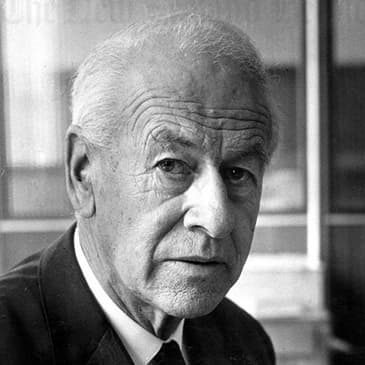
[00:00:01] Hello listeners, welcome to my podcast Acts, a Commentary by Dr. E. M. Blaiklock, M.A.. The Sermon, Acts 17, verses 22-31. This famous address is Paul's gospel to an audience without a background of Old Testament theology or Jewish thoughts. Luke's report is, of course, a brief report of an address which must have been very much longer.
[00:00:27] The Homiletics. Paul begins with an arresting statement. Athenians, I observe that in all respects you are an uncommonly religious people. Verse 22. The KJV rendering too superstitious is a mistranslation. The phrase was not disrespectful but did contain a touch of irony which the audience would find challenging. Above the scene and around and comprehended in that sweep of the hand which was characteristic of Paul's oratory
[00:00:56] were the famous shrines and gleaming statues of the Hellenic gods. Like Christ himself, Paul next attached his theme to a detail familiar to the experience of his hearers. For as I was passing through your city and noting the monuments of your devotion, I found also an altar dedicated to an unknown god. The Greek text has no article. An or the could both be legitimately supplied.
[00:01:24] There is plenty of evidence for such altars. Pausanias noticed altars to gods who are called unknown on his way from Phalerum to Athens. Philostratus mentions altars at Athens to the unknown deities. An altar has been found at Pergamum inscribed to the unknown deities. Such altars had no special deity in view. The dedication was designed to ensure that no god
[00:01:50] was overlooked to the possible harm of the city. In bold denial of the validity of the famous temples clustered round him, Paul then proceeded to state a fundamental doctrine in verses 24-28, and to reinforce his point by a verse from the Stoic poet Aratus of Soli in Cilicia, Paul's native country. After the quotation he drives home his point again, in verse 29.
[00:02:17] Note now something subtle and in tune with the method of Paul on another famous occasion. In Acts 23, verse 6, before the Sanhedrin, Paul divided his audience by appealing to one part. Here before him were Epicureans and Stoics. He rightly divined that the Stoic element was more open to his appeal. The determined materialism of the Epicurean listeners made sympathetic contact difficult.
[00:02:44] It is notable that verses 24 and 28 are couched in Stoic language, and quote two Stoic poets, Aratus and Cleanthes, who both used the words. Whether he was also quoting Epimenides, the Stoic, as Rendel Harris maintained, cannot, in view of the paucity of the fragments, be determined. In verse 29, the language is notably Stoic. To win a basis of agreement, Paul lays no emphasis on the
[00:03:12] personality of God. We ought not to think, he says, that the divine nature, or deity in the abstract, is like gold, or silver, or stone. Stoicism was pantheistic, the listening crowd was polytheistic. Paul begins with the simplest platform common to both. There is something divine, which the religious strive to please, and some philosophers seek to comprehend. It is the common fault of those
[00:03:40] who seek to commend the gospel to an alien or hostile audience by an adaptation of approach, or a recasting of language, to lose the point of their appeal, and leave their hearers with no vital challenge. Paul avoided this error. In verse 30 he reaches his main point. The last words were a frontal attack. The doctrine. Note first the lofty view of God. God the Creator stands first, and is Jewish in
[00:04:08] conception. God is self-sufficient, and is the God who provides all good things. Verse 25. Compare Genesis 2.7. Romans 8.32. Life and breath imply existence and its continuance.
[00:04:34] The equality of all men before him follows. Verse 26. Paul had clashed with the Jews on this subject, and must have been aware that his words were challenging Gentile prejudices as strong. It was the boast of the Athenians that they had sprung from the soil. The truth Paul put into these words cut at the root of all national pride, engendered by polytheism on the one hand,
[00:05:00] and philosophic pride on the other. The Stoic, especially Seneca and Epictetus, had glimpsed the truth of the unity of mankind under God, but such philosophy lacked a lifting power. It was not given to the Greek or to the Roman, but to the Jew, separated though he was from every other nation, to safeguard the truth of the unity of mankind, and to proclaim the realization of the truth through the blood of a
[00:05:28] crucified Jew. Paul's view of sin, righteousness, and judgment is more bluntly expressed in the first three chapters of Romans. He is writing there to a body of believers. In the chapter before us he is speaking tactfully, but still uncompromisingly, to a thoughtful pagan audience. It is implied in Acts 17 that the pagan world had made little progress in searching for its creator. In Romans it is more vigorously
[00:05:57] stated that for all God's visible presence in his creation, the world at large had failed to find him. The call to repentance, verse 30, would be equally unwelcome to Stoic and Epicurean, to the latter because it would conflict not only with his denial of immortality, but with his whole notion of the gods, to the former because he regarded the wise man as self-sufficient, who stood in no need of atonement
[00:06:24] and need fear no judgment to come. The resurrection is set forth as the final authentication of the message. Proof is not detailed, either because Luke interrupted at this point.